
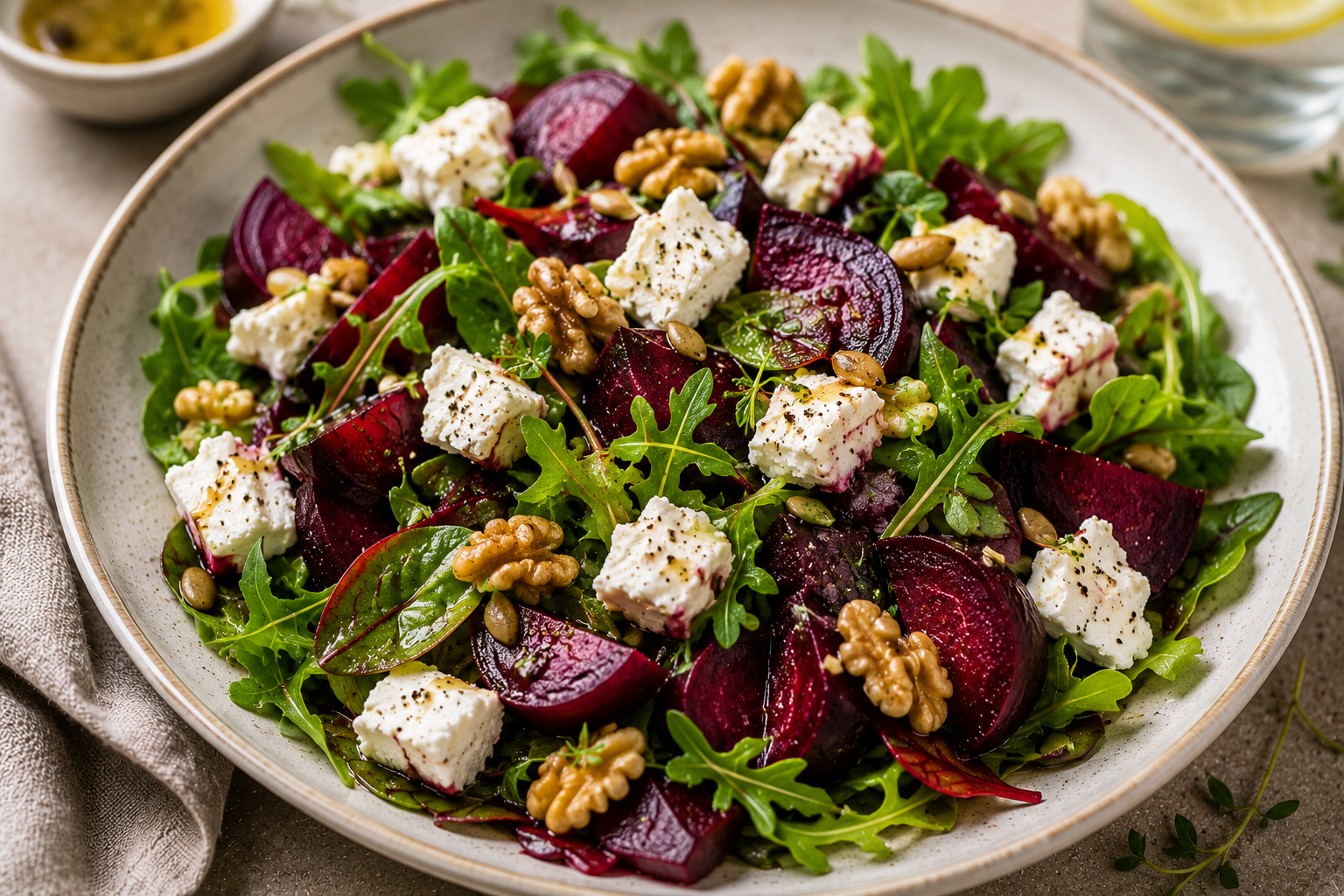
Beetroot and goat’s cheese is a classic pairing for a reason — the earthy sweetness of the beets against the creamy tang of the cheese is a proper flavour combination. Built into a generous salad with leaves, walnuts and a simple dressing, it makes a vibrant, balanced GLP-1 lunch at around 320 calories, with a good hit of protein and healthy fats to keep you satisfied.
A quick word first: I am not a doctor or a dietitian, just someone who lived this. None of these foods or supplements are medication, and if you are on a GLP-1, check anything new with your GP or pharmacist. Right, let us get to it.
For the full approach to eating on the jab, see my complete GLP-1 guide, and for hitting your protein, how much protein per day.
Why this salad is more than rabbit food
Salad has an image problem, but a properly built one like this is a real meal.
Goat’s cheese brings protein and flavour. A modest amount of goat’s cheese adds a satisfying protein hit and so much flavour that you do not need a big portion to feel indulged.
Beetroot is sweet, earthy and full of fibre. It gives the salad substance and natural sweetness, plus fibre and nitrates, for very few calories.
Walnuts add healthy fats and crunch. They bring omega-3, texture and staying power, turning a bowl of leaves into something that actually keeps you full.
How I learned to build a salad that fills you up
For most of my life, salad meant a limp side of leaves that left me hungry an hour later, which is exactly why I never took it seriously as a meal. The thing that changed everything was learning the formula for a salad that actually satisfies: leaves for volume, a protein to keep you full, a healthy fat for staying power and flavour, something sweet or substantial for interest, and a proper dressing to bring it together. Get that balance and a salad becomes a genuinely filling meal rather than a punishment.
This beetroot and goat’s cheese salad is that formula in action — leaves, cheese for protein, walnuts for fat, beetroot for substance, a simple dressing to finish. Once you understand the structure, you can build endless versions and never be hungry an hour later again. That was a genuine unlock for me on the jab.
The macros that matter
Here is roughly what one serving gives you. Treat these as a guide rather than gospel, since it depends on your exact ingredients and portions:
| Approx per serving | Amount |
|---|---|
| Calories | ~320 kcal |
| Protein | 12g |
| Carbohydrate | 22g |
| Fat | 20g |
| Fibre | 6g |
The protein figure is the one I watch on a GLP-1. As a rough guide I aim for somewhere around 1.2 to 1.6g of protein per kilo of body weight across the day to protect muscle while losing fat, and I judge every meal by how much of that it contributes. I log meals like this in Cronometer (it is free) so I know I am actually hitting my targets rather than hoping. The first time I tracked properly I realised I was eating far less protein than I thought, so if you have never done it, give it two weeks.
What you need (serves 1)
- 2 handfuls of mixed salad leaves (rocket works beautifully)
- 2 cooked beetroot, sliced or diced
- 40g goat’s cheese, crumbled
- A small handful of walnuts, roughly chopped
- 1 tsp olive oil
- 1 tsp balsamic vinegar
- ½ tsp honey
- Salt and black pepper
- Optional: a scatter of pumpkin seeds
How to make it
- Pile the salad leaves onto a plate or into a bowl as your base.
- Arrange the sliced or diced beetroot over the leaves.
- Scatter over the crumbled goat’s cheese and chopped walnuts.
- Whisk together the olive oil, balsamic vinegar, honey, salt and pepper to make a quick dressing.
- Drizzle the dressing over the salad just before serving.
- Add a scatter of pumpkin seeds for extra crunch if you like, and serve.
Making it a higher-protein meal
At 12g this is a balanced but light lunch, so on a hungrier day:
Add grilled chicken. The classic addition — it turns this into a substantial 30g-plus protein meal.
Add a boiled egg or extra cheese. Either bumps the protein while keeping it vegetarian.
Add chickpeas or lentils. For a plant-based protein and fibre boost. See how much protein per day for how I set my numbers.
Getting the dressing right (and keeping it honest)
The dressing makes or breaks a salad, but it is also where a supposedly healthy lunch can quietly gain a couple of hundred calories if you are not paying attention. Shop-bought dressings are often loaded with sugar and oil. Making your own takes thirty seconds and puts you in control: a teaspoon of good olive oil, a teaspoon of balsamic, a tiny bit of honey to balance, and seasoning. That is all you need to bring the whole salad together, and you know exactly what is in it. The little bit of honey is worth keeping, because it balances the acidity and the earthy beetroot beautifully — it is a case of a small amount of something sweet doing a real job rather than being empty calories.
Prep the parts, assemble fresh
Salads are best assembled fresh so the leaves stay crisp, but the components prep brilliantly. Keep cooked beetroot in the fridge, walnuts to hand and a little jar of dressing made up, and this comes together in two minutes. If taking it to work, keep the dressing separate and add it just before eating so nothing goes soggy. A good compartment lunch box makes that easy. Part of my meal prep ideas for Mounjaro.
How it fits a full day of eating
At 12g of protein this is a balanced lunch but not a high-protein one, so I make sure the rest of the day delivers — a solid breakfast from my high-protein breakfasts and a proper high-protein dinner. If I add chicken or egg to the salad, it stands as a complete meal on its own.
The healthy fats from the walnuts and cheese keep me full through the afternoon, so I rarely need much after it, though high-protein snacks or a protein shake is there if needed. The GLP-1 rule holds: hit your protein across the day, and build each meal to contribute. My complete GLP-1 guide explains the framework.
No appetite today?
On a low-appetite day, even a few forkfuls of this — some beetroot, a bit of cheese, a few leaves — gets quality food in without overwhelming you. When cooking or assembling anything feels like too much, HelloFresh keeps ready meals coming. More in what to eat with no appetite.
Supplements that pair well
The walnuts give you some plant omega-3, but I still top up with Super Omega-3 EPA, and through winter I take Vitamin D3 + K2 for immune and bone support. A salad-based lunch is a good sign your diet is on track; the free Lily & Loaf lifestyle analysis can fine-tune the rest of your routine.
Frequently asked questions
Is this salad filling enough for a meal?
As a balanced light lunch, yes — the goat’s cheese, walnuts and beetroot give it real substance. For a hungrier day, add grilled chicken or a boiled egg to make it more filling.
Can I use pre-cooked beetroot?
Absolutely — vacuum-packed cooked beetroot (the plain kind, not in vinegar) is a huge time-saver and works perfectly. It is what I usually use.
How do I make it higher in protein?
Grilled chicken is the classic addition for 30g-plus. A boiled egg, extra cheese, or chickpeas all work too, depending on whether you want it meaty or vegetarian.
Is goat’s cheese OK on a diet?
In moderation, yes — it is flavourful, so a little goes a long way, and 40g adds useful protein without too many calories. It is a smart way to add flavour and protein at once.
Can I make the dressing in advance?
Yes — make a small jar and keep it in the fridge for a few days. Making your own keeps the sugar and calories far lower than most shop-bought dressings.
The bottom line
Beetroot and goat’s cheese salad is proof that a salad can be a proper, satisfying meal — earthy, creamy, crunchy and balanced, at around 320 calories with real protein and healthy fats. Learn the build (leaves, protein, fat, substance, dressing) and you will never be hungry an hour later again. Add chicken or egg for a higher-protein version. To fine-tune the supplements around a routine like this, the free Lily & Loaf lifestyle analysis is a two-minute, no-pressure starting point.
The tools I lean on
If you are putting a GLP-1 routine together, this is the order I would do it in, free tools first:
- Track a fortnight of food in Cronometer so you can see your real protein and calories.
- Take the free Lily & Loaf lifestyle analysis to find the supplements actually worth buying.
- Start an Audible trial for something to listen to while you cook or walk.
- Keep HelloFresh on standby for the weeks cooking from scratch just is not happening.
A bit about me
I am Alan Spicer. I lost around seven stone on Mounjaro and filmed the whole thing, warts and all, on my YouTube channel. Simple, protein-first lunches like this were a real part of how I held onto muscle and kept the weight off.
This article shares my personal experience and general information only. It is not medical advice. Food and supplements support a balanced diet and healthy lifestyle and do not replace it or any treatment prescribed by your doctor. Speak to your GP or pharmacist before making changes, especially while on a GLP-1 medication. Nutrition figures are approximate and will vary with the exact ingredients and brands you use.
Inspired by the kind of fresh, wholefood lunches in the Lily & Loaf lunches collection. This is my own version, written from my own kitchen.
Discover more from Healthy Weight Loss GLP1
Subscribe to get the latest posts sent to your email.