
A food scale is a boringly effective weight loss tool that costs under £25 and changes how accurately you understand what you’re eating. On a GLP-1, where every gram of protein counts more (because your total intake is smaller), owning one is arguably non-optional. This is the 2026 UK guide to picking one that lasts, along with how to use it so it actually helps rather than gathering dust.
For the kitchen gear overview see Kitchen Gear Worth Buying in the Complete Guide. For air fryers and other appliances, Best Air Fryer for Weight Loss UK 2026.
Why a food scale specifically matters on a GLP-1
Three practical reasons the scale earns its counter space:
1. Portion estimation is wildly unreliable. Study after study shows people under-estimate their food intake by 20–40%, and over-estimate protein intake by similar margins. When your total calorie intake is 1,400 and you need 130g protein out of it, the margin for estimation error is tiny. A scale removes the guesswork.
2. Your protein target depends on accurate weighing. “A chicken breast” might be 120g or 200g. “A handful of almonds” might be 15g or 45g. The difference between hitting 1.6g/kg protein and missing it by 20g is often just the difference between weighing and eyeballing.
3. Appetite-suppressed eating creates a specific risk. Reduced appetite plus reduced food intake means small errors in protein estimation compound into meaningful deficits that directly affect muscle preservation. Weighing prevents the slow drift into under-eating protein.
This isn’t about obsessive calorie tracking. It’s about knowing that the 150g of chicken you thought you cooked is actually 150g of chicken, and therefore actually 35g of protein rather than whatever estimate you’d otherwise make.
What to look for in a food scale
Five things actually matter. Most of the marketing doesn’t.
1. Accuracy to 1 gram. Anything that only resolves to 5g increments is useless for small portions (protein powder scoops, nut portions, spices). 1g increments are the minimum; some scales go to 0.1g which is overkill for most food but useful for coffee or small-portion needs.
2. Tare function. The “zero” button that lets you add ingredients one at a time to a bowl and weigh each individually. Without this, you’re using a scale from 1980; every decent scale has it.
3. Unit switching (grams, oz, ml, lb). Grams and ounces for most cooking; ml useful for liquids (though technically weighing liquids in grams is equivalent for most water-based liquids). UK recipes mix systems; a scale that toggles is essential.
4. Flat top / wipe-clean surface. Stainless steel or tempered glass platform. Crevices or raised edges trap food residue and make cleaning awful.
5. Capacity. At minimum 5kg / 11lb. Bigger is better; you never want to find out mid-weigh that your scale maxes out at 3kg while you’re weighing a whole chicken.
Things that matter less than marketing suggests: Bluetooth connectivity, app integration, “smart” features that recognise food types, built-in nutrition databases (they’re always out of date and wrong), fancy LCD colour displays.
UK food scale picks for 2026
Best all-rounder: Salter Arc Digital Kitchen Scale
5kg capacity, 1g accuracy, stainless steel platform. Around £15–£20.
Salter has made UK kitchen scales since 1760; they understand the category. The Arc Digital is the sensible default: flat stainless steel platform, large easy-read display, clear tare button, wipes clean, 15-year quiet reliability reputation. Runs on AAA batteries (replace annually with regular use).
Most UK households probably already own a Salter scale. If you don’t, this is the buy.
Buy from: Salter Arc Digital on Amazon UK.
Best premium: OXO Good Grips Stainless Steel Scale
5kg capacity, 1g accuracy, pull-out display. Around £40–£55.
The premium kitchen scale that justifies its price. OXO’s innovation is a pull-out display so you can still read the weight when weighing a large bowl that otherwise hides the screen. Build quality is excellent, surface wipes clean perfectly, tare is responsive, will last a decade of daily use.
Worth the premium if you cook a lot and appreciate well-designed kitchen tools. Overkill for occasional weighing.
Buy from: OXO Good Grips Scale on Amazon UK.
Best compact: Joseph Joseph TriScale
5kg capacity, 1g accuracy, folding design. Around £35–£45.
For small kitchens or people who hate appliance clutter, the TriScale folds flat when not in use — three arms fold out to support weighing, then tuck away into a slim 2cm-thick package. Good accuracy, clear display, unit conversion.
Trade-off: fiddly to use quickly compared to a flat-platform scale, and the folding design introduces more parts that could eventually fail. For kitchen-minimalists this is the pick; for daily-use utility, a flat scale is better.
Buy from: Joseph Joseph TriScale on Amazon UK.
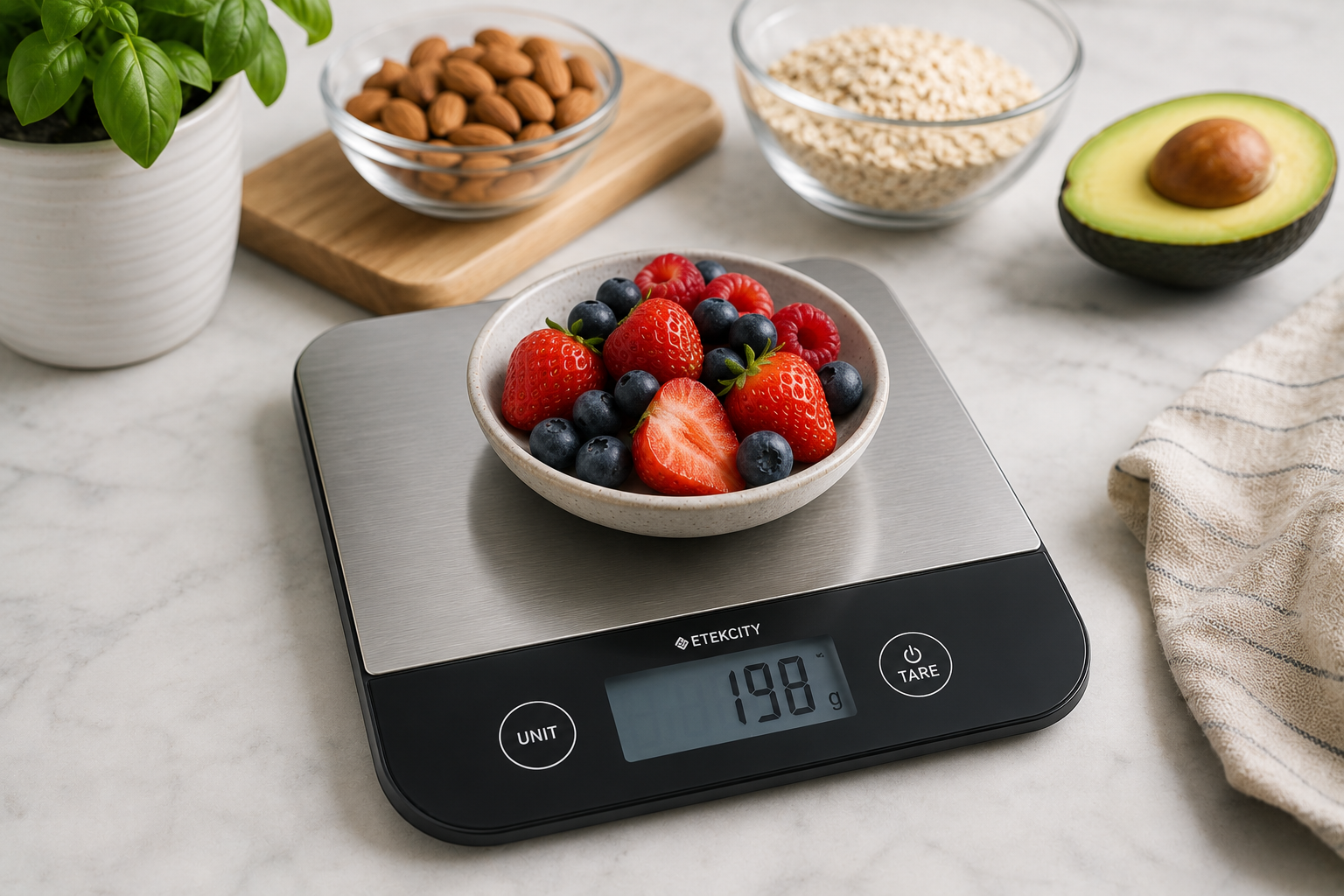
Best budget: Etekcity Food Kitchen Scale
5kg capacity, 1g accuracy, stainless steel. Around £10–£14.
The honest budget pick. Etekcity is a no-frills brand that sells kitchen gadgets through Amazon; the build quality isn’t premium but for £12 it does everything the Salter does. If budget is tight and you just want a working food scale, this is fine.
Downsides: the battery compartment feels flimsier than premium brands, the display is smaller, and customer service is Amazon-mediated rather than through a UK brand.
Buy from: Etekcity Food Scale on Amazon UK.
Best 0.1g precision: Bonsenkitchen Digital Pocket Scale
500g capacity, 0.1g accuracy. Around £10.
Not a replacement for a full kitchen scale, but worth having alongside one if you weigh small portions frequently (protein powder scoops, coffee beans, spices). 0.1g precision picks up differences a 1g scale misses. Small, pocket-sized, battery-operated.
Most people don’t need this. Some — those tracking macros tightly or working with small ingredients — find it genuinely useful.
Buy from: Bonsenkitchen Pocket Scale on Amazon UK.
How to actually use it (without becoming miserable)
The mistake most people make with food scales is deciding to weigh everything and then burning out in three weeks. The sustainable approach is narrower.
Always weigh (the things that matter most)
- Raw protein portions. Chicken breast, salmon fillet, steak, mince. These are the foundation of your daily protein target; accuracy matters.
- Protein powder scoops. Scoop sizes vary wildly between brands and often the label scoop weight is optimistic. Weigh once per product to know what 30g actually looks like.
- Calorie-dense foods in small portions. Nut butters, oils, cheese, chocolate. These are the foods where a visual estimate goes wrong by 50%+ and the calorie consequences are real.
- Grains and legumes (cooked or dry). Rice, pasta, oats, quinoa. Dry vs cooked differ by 3x; whichever you track from, weigh it.
Don’t bother weighing
- Non-starchy vegetables. Broccoli, leafy greens, peppers, courgette, mushroom, tomatoes. Low-calorie-density, high-volume foods; eat as much as you want, don’t measure.
- Herbs and spices. Calorie contribution is negligible.
- Very small additions to other meals. A spoonful of Greek yogurt on top of something, a sprinkle of seeds, a drizzle of hot sauce. Not worth the friction.
- Restaurant meals. No scale access; estimation is the only option.
This 80:20 approach captures the calibration benefit (most of your intake accuracy) without the lifestyle impact (weighing every leaf of salad you eat).
The protein powder calibration exercise
A five-minute exercise worth doing on day one of owning a food scale: weigh the scoop in your current protein powder tub.
- Tare the scale with an empty glass or bowl on it.
- Scoop one level, shaken-flat scoop of your protein powder.
- Note the weight in grams.
- Check the tub label: what does it say one scoop should weigh?
Commonly, the label says “30g scoop” and you’ll actually be scooping 25–35g depending on how compacted the powder is and how “level” you scoop. If you were assuming 30g and actually getting 25g, you’ve been under-hitting protein by 4g per shake — over two daily shakes that’s 8g, 10% of a 80g daily shortfall target. Small calibrations like this have real impact.
Cooked vs raw: the trap most people fall into
Macros are almost always listed for raw (or dry) ingredients, but we eat them cooked. The weight change between raw and cooked is substantial:
- Chicken breast: loses ~25% weight when grilled (120g raw → 90g cooked)
- Rice: triples in weight when cooked (50g dry → 150g cooked)
- Pasta: roughly doubles (80g dry → 180g cooked)
- Salmon: loses ~20% when baked
- Oats: approximately doubles with water
- Mince: loses 25–30% when browned (fat and water out)
Pick one state (raw or cooked) and stick with it for a given food. Most people find weighing raw (before cooking) more accurate because the moisture content of cooked food varies with cooking method. But either works if consistent.
Common food scale mistakes
1. Weighing the packaging. Put the food on the scale without its packaging (pouch, bowl, wrapper). Tare first if using a container.
2. Not calibrating occasionally. Put a known weight on the scale (an unopened 1kg bag of rice, a litre bottle of water weighing ~1kg) every few months. If the displayed weight is dramatically off, the scale needs a battery or a replacement.
3. Only weighing when “being good.” Weigh on normal days too. The point is calibration, not pre-planned restriction.
4. Letting it become obsessive. If weighing starts creating anxiety or compulsive behaviour, step back. Food scales are tools for informed eating, not enforcement mechanisms for disordered behaviour.
5. Spending too much. £25 is plenty for a good kitchen scale. £100+ “smart” scales don’t materially improve the cooking experience over a Salter Arc.
When weighing isn’t the right answer
Scenarios where a food scale is the wrong tool:
- Active eating disorder history. Weighing food can re-trigger disordered patterns. Work with a specialist; food scales may or may not be appropriate for your recovery.
- If tracking generally triggers anxiety. Mental health first. You can do well on a GLP-1 without weighing if it’s not serving you.
- Eating out / social situations. Portion estimation is inevitable; don’t bring a scale to a restaurant. Relax and enjoy it.
- When the goal is intuitive eating re-learning. Some later stages of a weight-loss journey benefit from deliberately not weighing and relearning hunger/fullness cues.
The scale as a calibration tool, not a daily burden
The approach that works for most GLP-1 users: weigh consistently for 2–4 weeks, particularly your protein portions and calorie-dense foods. By the end of that period, your eye is genuinely calibrated — you’ll recognise what 150g of chicken looks like, what 30g of protein powder scoops to, what a 15g serving of peanut butter is. After that, weigh occasionally for re-calibration or when you’re working with a new food.
Most people who persist with weighing everything long-term either have existing tracking comfort (bodybuilders, disciplined macro-trackers) or are drifting toward obsessive patterns. The sustainable middle path is calibration-then-intuition.
My recommendation in one line
For most UK GLP-1 users: Salter Arc Digital Kitchen Scale for £15–£20. Use it daily for 2–4 weeks to calibrate your eye; then use it as-needed. If budget is really tight, Etekcity is fine for half the price. Skip the £40+ premium options unless you genuinely value the design features.
For the rest of the kitchen setup: Kitchen Gear Worth Buying. For the nutrition targets the scale helps you hit: The Nutrition Stack.
Disclosure: some links are affiliate links. Mental health note: weighing food isn’t right for everyone, particularly those with eating disorder history. Work with your health professional to decide what’s appropriate for your situation.
Discover more from Healthy Weight Loss GLP1
Subscribe to get the latest posts sent to your email.