

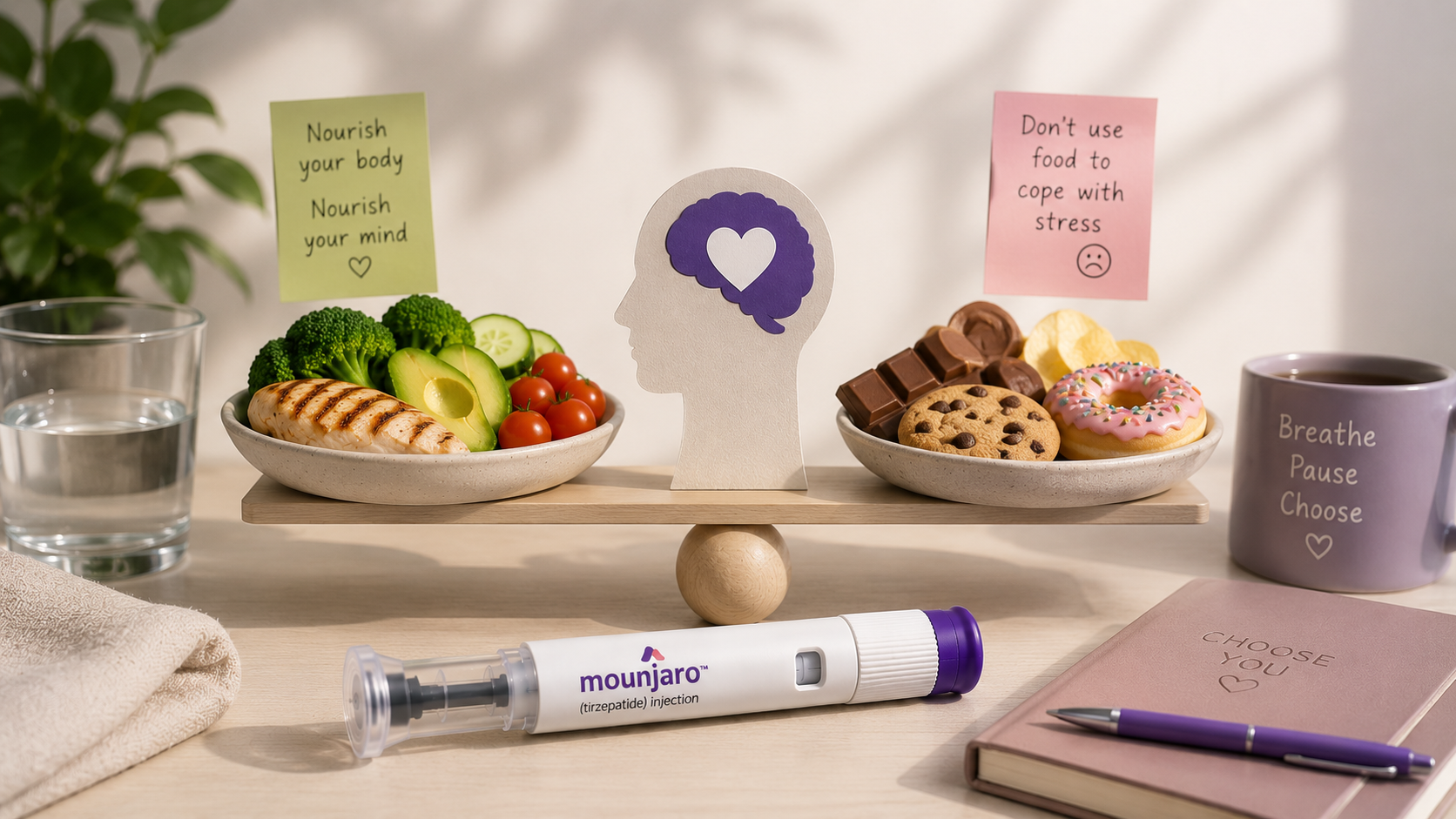
Mounjaro reduces food noise and appetite, but stress eating is driven by psychology as much as physiology — and the medication doesn’t fully remove the psychological urge to eat under stress. Some users find Mounjaro makes stress eating much less powerful because the physical pull toward food is quieter. Others find the urge persists but the food no longer delivers the same relief. Understanding which pattern you’re in — and having strategies that work with the medication rather than hoping it solves everything — is what this guide addresses.
For related reading: How to Stop Emotional Eating UK and Food Noise Explained on GLP-1.
How Mounjaro changes the stress eating picture
Stress eating typically runs through two pathways:
Pathway 1: physiological appetite amplification. Stress raises cortisol, which increases ghrelin (the hunger hormone). This creates a genuine physical appetite spike, particularly for high-calorie, high-carbohydrate foods. Mounjaro’s appetite suppression addresses this pathway directly — the medication reduces the physiological hunger signal, making stress-induced hunger less powerful.
Pathway 2: psychological coping behaviour. Eating as a response to stress, boredom, anxiety, or difficult emotions that has become habitual regardless of hunger. Mounjaro’s appetite suppression has limited effect on this pathway because the behaviour isn’t being driven by physical hunger — it’s being driven by emotional regulation needs that the food is meeting.
Many GLP-1 users are surprised to discover their stress eating persists in a modified form: the physical pull toward food is weaker, but the urge to open the fridge during a difficult phone call, to eat during anxious evenings, or to “reward” stress relief with food continues — just with less physiological reinforcement.
Three stress eating patterns on Mounjaro
Pattern 1: mostly resolved
Some users report that the food noise reduction from Mounjaro is sufficient to break stress eating cycles entirely. With the constant background pull toward food quieted, the habitual response to stress no longer automatically manifests as eating. These users typically had stress eating more driven by physical appetite than by deep psychological coping — the medication’s effect was sufficient.
Pattern 2: urge persists, but food is less satisfying
Many users find they still reach for food under stress, but it no longer delivers the same emotional relief. They eat a few bites of something, feel no particular satisfaction, and the eating behaviour fades. This is the medication reducing the reinforcement of the stress-eating loop — the behaviour persists initially but loses its payoff, which gradually extinguishes it.
This pattern is uncomfortable because the stress still needs managing and food no longer works as a tool. It requires actively finding and using alternative coping strategies during the transition.
Pattern 3: stress eating continues significantly
A minority of users find stress eating continues at broadly the same level as pre-medication — the appetite suppression doesn’t fully interrupt the pattern. For these users, the urge to eat under stress is primarily psychological and habitual rather than physiological, and the GLP-1’s appetite mechanism doesn’t address it adequately.
If this describes your pattern, medication alone isn’t sufficient. The psychological component requires specific attention.
What GLP-1 treatment uncovers
When food is removed as a primary coping mechanism (partially or fully), the underlying emotional needs it was meeting become more visible. Common experiences:
- Stress and anxiety that was previously “managed” through eating now feels more present
- Boredom that food was filling becomes more noticeable
- Emotional difficulties (grief, relationship stress, work pressure) that were being temporarily numbed by eating require different responses
- Social situations that revolved around food feel less satisfying
This uncovering is often described as uncomfortable — users report “feeling emotions more directly” than before. It’s not a side effect of the medication; it’s the consequence of removing something that was buffering emotional experience. Whether that buffering was helpful or not, its reduction requires adaptation.
Alternative coping strategies that work alongside Mounjaro
Replacing stress eating requires alternatives that actually reduce the stress state rather than just blocking access to food:
Physical movement: even a 10-minute walk reduces cortisol measurably. On Mounjaro where energy can be variable, a brief walk is accessible even on poor-energy days. It directly addresses the physiological component of stress that Pathway 1 describes.
Body-based calming: the stress response is physiological — heart rate up, breathing shallow, muscles tense. Physiological interventions that activate the parasympathetic system: slow breathing (4-second inhale, 6-second exhale, for 2–3 minutes), cold water on the wrists, brief progressive muscle relaxation. These work in the moment, without any preparation.
Timed delay: a simple rule that can break the automatic quality of stress eating — when the urge to eat under stress arises, commit to a 10-minute delay before acting on it. After 10 minutes, the cortisol spike that triggered the urge has often started to ebb and the automatic quality of the response has reduced. If you still want to eat after 10 minutes, eat a small protein-rich snack rather than a high-sugar option.
Journaling or talking: writing down what’s stressful or talking to someone directly addresses the emotional state rather than suppressing it with food. This is the slow work, not the in-moment crisis management — but regular practice reduces the accumulation of unprocessed stress that drives chronic stress eating.
Mindfulness practices: not as a vague wellness recommendation but as a specific behavioural tool. Awareness of the urge to eat under stress (noticing the impulse without immediately acting on it) creates a gap between stimulus and response. Over weeks of practice, this gap becomes easier to maintain. Apps: Headspace, Calm, Waking Up. See What is Mindfulness for the basics.
When to seek professional support
Stress eating is not a character flaw or a discipline problem — it’s a learned coping mechanism that typically developed for a reason. Professional support is appropriate when:
- Stress eating is severely undermining your Mounjaro results (eating significantly above what the medication would allow in calm states)
- Eating under stress feels out of control — eating more than you intended, eating secretly, distressing post-eating
- The emotional states driving stress eating (anxiety, depression, grief, trauma) are significant and persistent
- You recognise a binge eating pattern that medication doesn’t adequately reduce
Available support in the UK:
- GP referral for CBT (cognitive behavioural therapy) — NICE-recommended for disordered eating
- IAPT services (NHS talking therapies) available via self-referral in most areas
- BEAT Eating Disorders helpline: 0808 801 0677
- Private CBT therapists (BPS registered)
Tracking stress eating patterns
A useful two-week practice: note the emotional context of eating occasions in Cronometer‘s notes field. Not judgementally — just as data. “Ate because stressed about work call” vs “ate because it was mealtime and I planned this.” Over two weeks, the pattern of stress-triggered versus planned eating becomes visible. This awareness itself often begins to reduce automatic stress eating.
The pattern data also helps identify specific stress triggers that consistently drive eating — particular times of day, specific stressors, emotional states. Targeted interventions (walk after difficult meetings, have protein snack ready during evening anxiety) work better than generic “eat less when stressed” intentions.
Stress eating vs appropriate response to stress
One nuance worth naming: eating something when stressed is not inherently problematic. The distinction is:
- Eating a small protein-rich snack because stress has reduced your appetite all day and you need fuel — fine
- Eating large amounts of high-calorie food to suppress an emotional state you’re not ready to feel — worth addressing
Mounjaro doesn’t require you to eliminate food as part of your emotional landscape. It simply reduces the physiological drive that was making the unhelpful version of stress eating so automatic.
Frequently asked questions
Does Mounjaro stop stress eating?
It reduces the physiological component (appetite amplification from cortisol/ghrelin) but doesn’t fully address the psychological/habitual component. Many users find it significantly helps; some find the pattern persists. The medication works with behavioural strategies, not instead of them.
Why do I still want to eat when stressed on Mounjaro?
Because the urge is partly habitual and psychological, not purely physical. The medication quiets the physical hunger signal; the psychological association between stress and eating is a learned behaviour that requires its own work to change.
Is stress eating a sign of binge eating disorder?
Not necessarily. Stress eating is a common and very normal human behaviour. BED is characterised by episodes of eating unusually large amounts very rapidly, often with distress and a sense of loss of control, typically in the absence of hunger. If this describes your experience, discuss it with a GP or the BEAT helpline.
What’s the best snack to have when stress eating strikes on Mounjaro?
If you’re going to eat, a small protein and fat combination (a few nuts and some Greek yoghurt, or a boiled egg with a small amount of cheese) provides satisfaction with minimal blood sugar disruption and reasonable nutritional value. This doesn’t solve the stress eating pattern but reduces its caloric impact while you work on the underlying behaviour.
Building new reward structures
One of the more constructive things you can do with the mental space that food previously occupied is deliberately building alternative reward structures. This isn’t about replacing food with “healthy hobbies” — it’s about identifying what function food-as-reward was serving and finding other ways to meet that function.
Common functions food served as a reward:
- Comfort: physical warmth, something nice tasting, a sensory break. Replacements: hot bath, warm drink (herbal tea, decaf coffee), a blanket on the sofa, a scented candle — physical comfort alternatives
- Celebration: acknowledging achievement or the end of something difficult. Replacements: a specific non-food treat you’ve identified (a specific podcast episode, a small purchase, calling someone who celebrates with you)
- Transition marker: food as the signal that “work mode” has ended and “rest mode” has begun. This is surprisingly powerful — the act of eating was marking the transition. Replacement: a specific short walk, a specific piece of music, a ritual that marks the transition without food
- Social connection: bonding over food with others. This doesn’t need replacing — shared meals continue on Mounjaro, just in smaller quantities
None of these replacements feel as immediately satisfying as the food habit they’re replacing, at least initially. That’s expected — neural pathways built over years don’t redirect in weeks. But the reduced food reward intensity from Mounjaro means the gap between “food reward” and “alternative reward” is smaller than it would be without the medication — which is actually when behaviour change is most feasible.
Discover more from Healthy Weight Loss GLP1
Subscribe to get the latest posts sent to your email.