
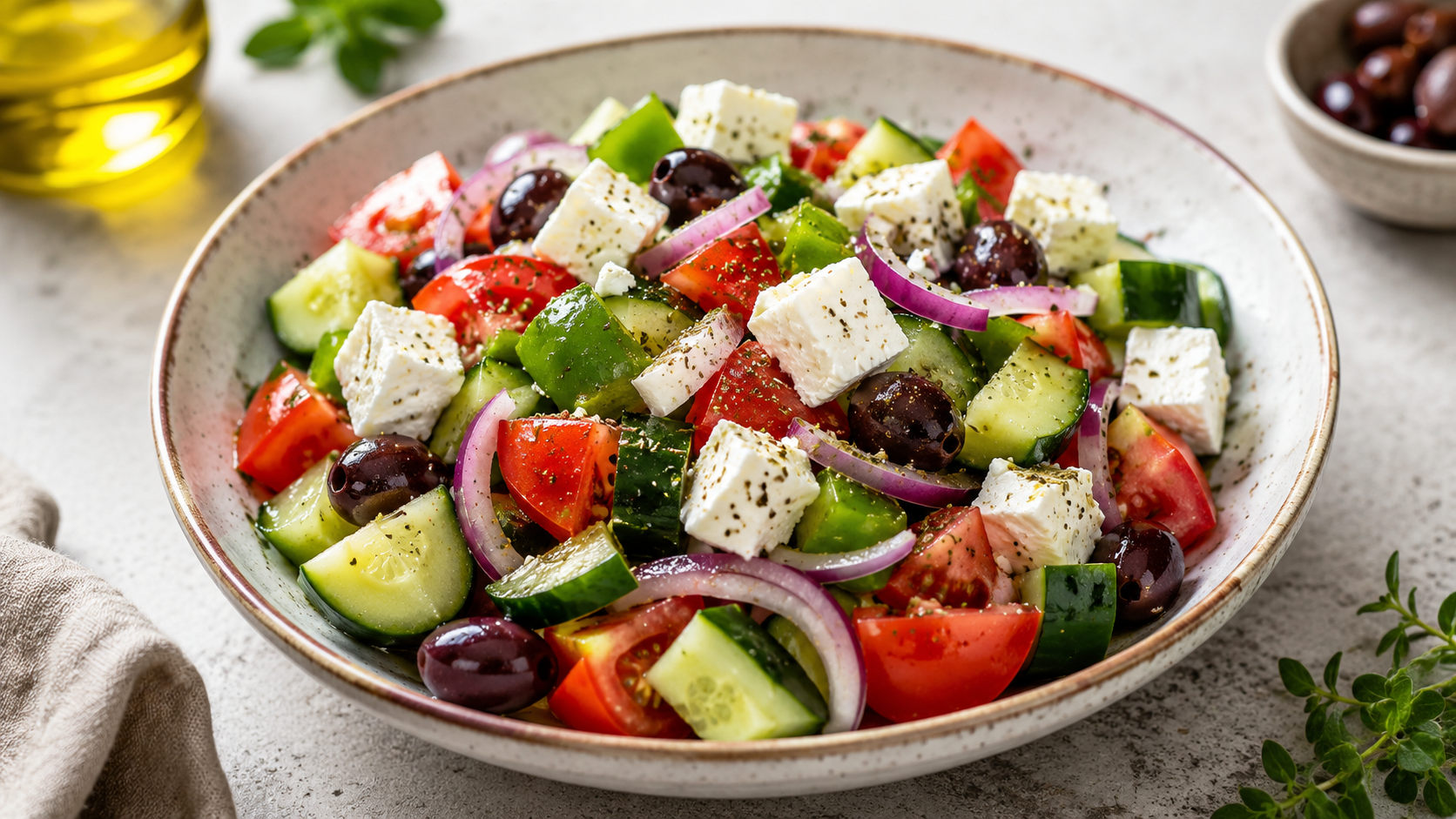
A proper chunky Greek salad is the perfect fresh side to almost any protein — ripe tomatoes, cucumber, red onion, olives and a slab of feta, dressed simply with olive oil and oregano. It brings a burst of Mediterranean freshness and a little protein and healthy fats for around 180 calories, and it is one of the most reliable, go-with-everything sides you can make on a GLP-1.
A quick word first: I am not a doctor or a dietitian, just someone who lived this. None of these foods or supplements are medication, and if you are on a GLP-1, check anything new with your GP or pharmacist. Right, let us get to it.
For the wider approach to eating on the jab, see my complete GLP-1 guide, and for hitting your protein, how much protein per day.
Why a Greek salad is the ideal side
Some dishes are classics because they simply work, and a Greek salad is one of them.
It goes with almost any protein. Grilled chicken, fish, lamb, prawns — a fresh Greek salad complements them all, making it an endlessly useful side to have in your repertoire.
Feta brings protein and flavour. A proper chunk of feta adds a satisfying protein hit and so much salty, tangy flavour that the whole salad sings.
Fresh, low-carb and full of veg. It is essentially a pile of fresh vegetables with a little cheese, so it adds nutrients and fibre to your plate for very few carbs.
Why a good side turns a plain protein into a meal
On a protein-first diet, it is easy to end up staring at a lonely piece of grilled chicken or fish and feeling a bit uninspired. The protein is doing its job nutritionally, but a plain slab of it does not feel like a proper, satisfying meal, and that lack of satisfaction is what can send you looking for something more. This is where a good side earns its place. A fresh, generous Greek salad alongside that same chicken breast transforms it from a joyless bit of diet food into a proper Mediterranean plate that you genuinely want to eat. The side does the work of making the meal feel complete and satisfying.
That is the real value of building a repertoire of good sides on a GLP-1. Your protein is the priority and the foundation of the meal, but the sides are what make it enjoyable, add your vegetables and fibre, and turn nutrition into an actual meal you look forward to. A Greek salad is one of the best for this because it is fresh, vibrant, endlessly reliable and goes with almost anything. It takes five minutes, needs no cooking, and instantly elevates whatever protein it sits next to. Getting into the habit of pairing your proteins with a proper side like this — rather than eating the protein alone — is a simple shift that makes healthy eating far more satisfying and gets a lot more veg into your day. It is not about the side being the star; it is about the side making the whole plate work.
The macros that matter
Here is roughly what one serving gives you. Treat these as a guide rather than gospel, since it depends on your exact ingredients and portions:
| Approx per serving | Amount |
|---|---|
| Calories | ~180 kcal |
| Protein | 6g |
| Carbohydrate | 10g |
| Fat | 14g |
| Fibre | 4g |
The protein figure is the one I watch on a GLP-1. As a rough guide I aim for somewhere around 1.2 to 1.6g of protein per kilo of body weight across the day to protect muscle while losing fat, and I judge every meal by how much of that it contributes. I log meals like this in Cronometer (it is free) so I know I am actually hitting my targets rather than hoping. The first time I tracked properly I realised I was eating far less protein than I thought, so if you have never done it, give it two weeks.
What you need (serves 1)
- 2 ripe tomatoes, cut into chunks
- ½ cucumber, cut into chunks
- ¼ red onion, sliced
- A handful of Kalamata olives
- 50g feta, in a slab or cubed
- 1 tbsp extra virgin olive oil
- 1 tsp red wine vinegar
- ½ tsp dried oregano
- Black pepper
- Optional: a handful of green pepper chunks
How to make it
- Cut the tomatoes and cucumber into generous, chunky pieces — a Greek salad is meant to be rustic, not finely chopped.
- Combine the tomatoes, cucumber, red onion and green pepper if using in a bowl.
- Add the olives.
- Place the feta on top, either as a traditional slab or cubed through the salad.
- Drizzle with the olive oil and red wine vinegar, scatter with dried oregano and black pepper.
- Serve straight away, or let it sit a few minutes so the flavours mingle — no need to salt heavily, as the feta and olives are salty.
Adapting it
This classic is easy to tune:
Make it a main. Add grilled chicken, prawns or chickpeas to turn the side into a complete high-protein meal.
Boost the protein. Use a bit more feta, or add a boiled egg, while keeping it vegetarian.
Add leaves or grains. Bulk it out with rocket, or a little cooked quinoa for a more substantial side. See fibre on GLP-1.
Why ripe, in-season tomatoes matter so much
A Greek salad is one of those simple dishes where the quality of a few key ingredients makes or breaks the whole thing, and the tomatoes are the most important of all. A great Greek salad made with ripe, sweet, in-season tomatoes is a revelation; the same salad made with pale, hard, watery, out-of-season tomatoes is a real disappointment, no matter what else you do. This is because in a dish this simple, with so few ingredients and minimal dressing, there is nowhere for a poor ingredient to hide — the tomatoes are front and centre, and they need to taste of something. Ripe summer tomatoes are sweet, juicy and full of flavour; the watery winter ones sold in many supermarkets are bred for shelf life and appearance rather than taste, and they simply cannot carry the dish. So my advice is to make this salad when tomatoes are at their best, in the summer months, and to seek out the ripest, tastiest tomatoes you can find — vine tomatoes, cherry tomatoes, or proper ripe salad tomatoes, ideally ones that actually smell of tomato. Let them come to room temperature before serving, too, as cold from the fridge dulls their flavour. Out of season, you are better off using the sweetest small cherry or plum tomatoes you can find, which tend to have more flavour than large watery ones. This principle — that simple dishes live or die on the quality of their few ingredients — is worth remembering across your cooking. When a recipe has only a handful of components and little to mask them, spend your effort and money on getting those few components as good as possible. For a Greek salad, that means great tomatoes and decent feta, olives and olive oil, and the rest looks after itself.
Prep the parts, dress fresh
A Greek salad is best assembled fresh so the veg stays crisp and the tomatoes juicy, but the prep is minimal. You can chop the sturdier veg like cucumber and onion ahead, but dress it just before serving so it does not go watery. It is quick enough to make on the spot alongside a protein, and a lovely fresh addition to my meal prep ideas for Mounjaro in the warmer months.
How I use it alongside my meals
This is my go-to side for pairing with a protein and turning it into a proper Mediterranean plate. Alongside grilled chicken, fish, lamb or prawns from my high-protein dinner ideas, a fresh Greek salad adds vegetables, fibre, a little protein from the feta, and a burst of freshness that makes the whole meal feel complete and satisfying rather than like plain diet food.
The feta gives it a bit more protein than most vegetable sides, which is a nice bonus, but I still get the bulk of my protein from the main event. Think of this as the side that makes your protein enjoyable and gets your veg in. And with a protein or some chickpeas added, it easily becomes a complete meal in its own right. My complete GLP-1 guide explains how the whole plate fits together.
When your appetite is low
Fresh, light and salty, a Greek salad can be appealing on a low-appetite day when heavier food is not, and even a few forkfuls alongside a little protein get veg and nutrients in gently. When cooking or assembling feels like too much, HelloFresh keeps proper meals coming. More in what to eat with no appetite.
Supplements that pair well
As a fresh, veg-rich side it fits a healthy routine well. The feta adds a little gut-friendly dairy that a probiotic like Pre + Pro 15 builds on, and being low in omega-3 I top up with Super Omega-3 EPA. The free Lily & Loaf lifestyle analysis matches a routine to your goals.
Frequently asked questions
What makes a good Greek salad?
Ripe, in-season tomatoes above all, plus good feta, proper Kalamata olives, quality olive oil and a rustic, chunky cut. In such a simple dish, the quality of the few ingredients is everything, so buy the best tomatoes you can.
Is Greek salad good for weight loss?
Very — it is essentially fresh vegetables with a little cheese, so it is low in carbs and calories while adding nutrients and fibre. The feta brings a bit of protein, and it makes a brilliant side to any lean protein.
Can I make it a full meal?
Easily — add grilled chicken, prawns or chickpeas for protein, and some leaves or a little quinoa for bulk, and the side becomes a complete, satisfying high-protein meal.
Should I salt it?
Go easy — the feta and olives are already quite salty, so the salad rarely needs much added salt. Taste before adding any, and let the oregano, olive oil and vinegar do the seasoning work.
Can I prepare it ahead?
Chop the sturdier veg ahead, but dress it just before serving so it does not go watery, and use ripe tomatoes at room temperature for the best flavour. It is best fresh, so assemble close to serving.
The bottom line
A chunky Greek salad is the fresh, reliable side that goes with everything — ripe tomatoes, cucumber, olives and feta for around 180 calories, adding veg, fibre and a little protein to any plate. A good side turns a plain protein into a proper, satisfying meal, which is what makes protein-first eating enjoyable and gets your veg in. Use the best tomatoes you can find, and add a protein to make it a meal. To match your supplements to a fresh, veg-rich diet, the free Lily & Loaf lifestyle analysis is a quick, no-pressure check.
The tools I lean on
If you are putting a GLP-1 routine together, this is the order I would do it in, free tools first:
- Track a fortnight of food in Cronometer so you can see your real protein and calories.
- Take the free Lily & Loaf lifestyle analysis to find the supplements actually worth buying.
- Start an Audible trial for something to listen to while you cook or walk.
- Keep HelloFresh on standby for the weeks cooking from scratch just is not happening.
A bit about me
I am Alan Spicer. I lost around seven stone on Mounjaro and filmed the whole thing, warts and all, on my YouTube channel. Simple, nutrient-packed sides like this helped me eat more veg, add fibre, and keep my meals interesting while the weight came off.
This article shares my personal experience and general information only. It is not medical advice. Food and supplements support a balanced diet and healthy lifestyle and do not replace it or any treatment prescribed by your doctor. Speak to your GP or pharmacist before making changes, especially while on a GLP-1 medication. Nutrition figures are approximate and will vary with the exact ingredients and brands you use.
Inspired by the kind of fresh, wholefood sides in the Lily & Loaf sides collection. This is my own version, written from my own kitchen.
Discover more from Healthy Weight Loss GLP1
Subscribe to get the latest posts sent to your email.