
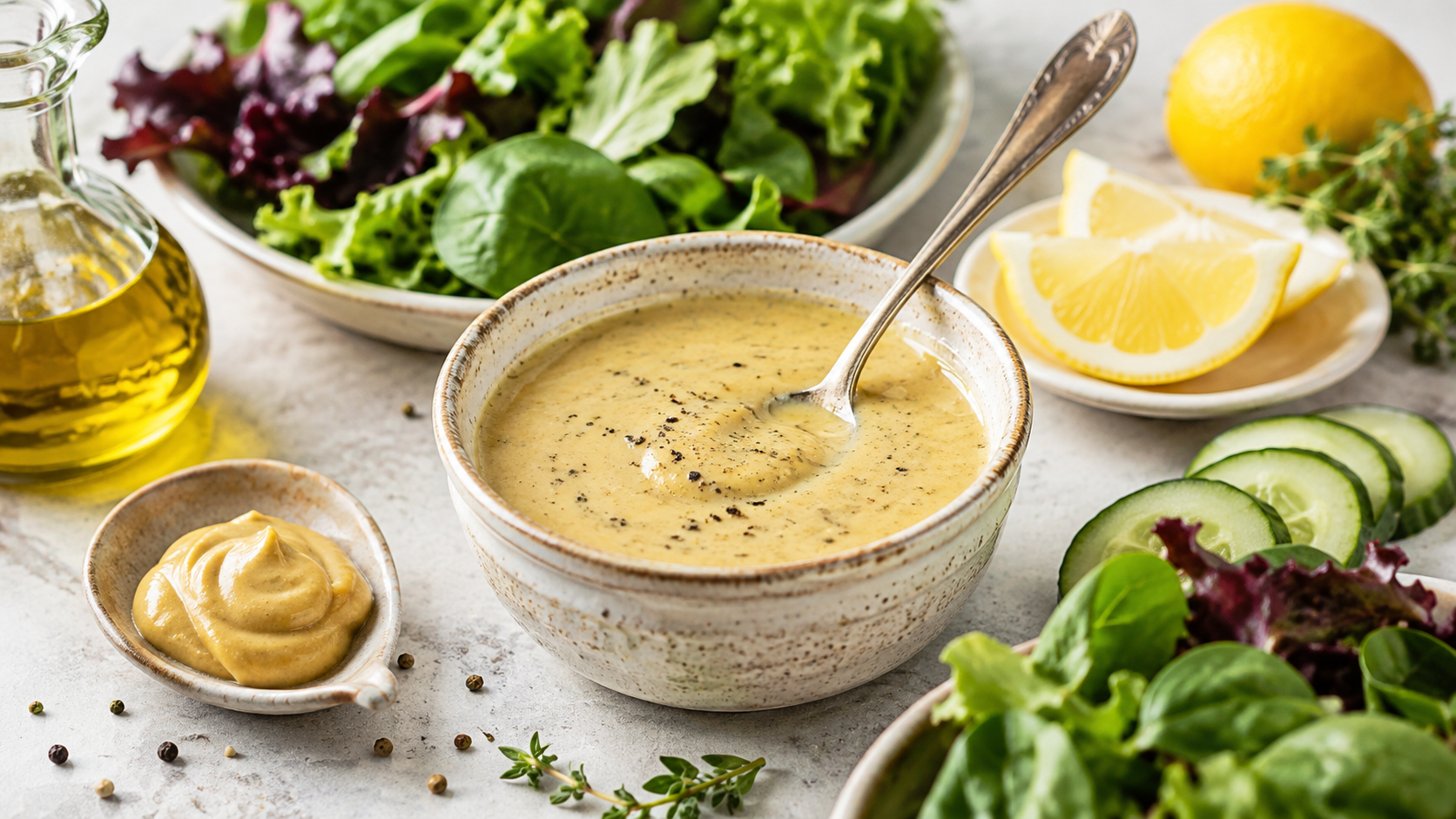
A good dressing is the difference between a salad you endure and a salad you enjoy, and making your own puts you in complete control. This Dijon dressing — mustard, olive oil, vinegar and a touch of honey — takes thirty seconds to make and beats almost anything you can buy, at around 90 calories a serving. On a GLP-1, where making veg genuinely appealing matters, a great homemade dressing is a small thing that makes a big difference.
A quick word first: I am not a doctor or a dietitian, just someone who lived this. None of these foods or supplements are medication, and if you are on a GLP-1, check anything new with your GP or pharmacist. Right, let us get to it.
For building satisfying salads on the jab, see my complete GLP-1 guide, and for fibre, fibre on GLP-1.
Why homemade dressing is worth it
It sounds like a small thing, but making your own dressing is one of the easiest upgrades to eating well.
You control the sugar and calories. Shop dressings, especially low-fat ones, are often loaded with sugar; making your own lets you keep it low and know exactly what is in it.
It makes salads genuinely appealing. A great dressing turns a bowl of leaves into something you look forward to, which is the whole battle in getting more veg and fibre in.
It takes thirty seconds. A quick whisk or shake in a jar, and it keeps for days — there is genuinely no reason to buy the bottled stuff.
How a good dressing changed my relationship with salad
For most of my life I thought I did not like salad, and it took me a surprisingly long time to realise the truth: I did not dislike salad, I disliked bad salad, and bad, boring dressing was almost always the culprit. A pile of undressed or badly dressed leaves is genuinely joyless, and no wonder I avoided it. The revelation, when I finally started making my own dressings, was that a well-made dressing transforms a salad completely. Suddenly the same leaves I had always found dull became something I actively enjoyed. It changed my whole relationship with vegetables.
This matters enormously on a GLP-1, because getting enough veg and fibre in is one of the real challenges when your appetite is smaller, and you are far more likely to eat your salad if it tastes great. A good dressing is the cheapest, easiest way to make that happen. The other thing I learned is that most shop-bought dressings, particularly the low-fat and fat-free ones marketed as healthy, are often stuffed with sugar and additives to make up for the missing fat, so they are not the virtuous choice they appear to be. Making your own thirty-second dressing means you know exactly what is in it, you can keep the sugar low, and it tastes far better. This Dijon dressing is my everyday go-to — sharp, savoury and just a touch sweet — and having a jar of it in the fridge is a genuine nudge towards eating more salad. Do not underestimate how much a good dressing can change your enjoyment of healthy food; it turned me from a salad-avoider into someone who genuinely looks forward to a big, well-dressed bowl of veg.
The macros that matter
Here is roughly what one serving gives you. Treat these as a guide rather than gospel, since it depends on your exact ingredients and portions:
| Approx per serving | Amount |
|---|---|
| Calories | ~90 kcal |
| Protein | 0g |
| Carbohydrate | 2g |
| Fat | 9g |
| Fibre | 0g |
The protein figure is the one I watch on a GLP-1. As a rough guide I aim for somewhere around 1.2 to 1.6g of protein per kilo of body weight across the day to protect muscle while losing fat, and I judge every meal by how much of that it contributes. I log meals like this in Cronometer (it is free) so I know I am actually hitting my targets rather than hoping. The first time I tracked properly I realised I was eating far less protein than I thought, so if you have never done it, give it two weeks.
What you need (serves 1)
- 1 tsp Dijon mustard
- 2 tbsp extra virgin olive oil
- 1 tbsp red or white wine vinegar
- ½ tsp honey (or maple syrup)
- 1 small clove garlic, crushed (optional)
- Salt and black pepper
- A little water to loosen if needed
- Makes several servings
How to make it
- Put the Dijon mustard, vinegar, honey, garlic if using, salt and pepper in a jar or bowl.
- Whisk together, or seal the jar and shake, until combined.
- Slowly add the olive oil while whisking (or keep shaking) so it emulsifies into a smooth, slightly thick dressing.
- Taste and adjust — more vinegar for sharpness, more honey to balance, more salt as needed.
- Loosen with a little water if it is too thick.
- Store in the jar in the fridge and shake before each use.
Variations to try
Once you have the basic ratio, you can vary it endlessly:
Make it creamy. Whisk in a spoon of Greek yoghurt for a creamy, higher-protein dressing.
Add herbs. Fresh chopped herbs, or a little dried oregano, make a herby version.
Go lighter. Use less oil and more water or vinegar for a lower-calorie dressing. See fibre on GLP-1.
The dressing ratio you can use forever
Once you understand the basic formula behind a vinaigrette, you never need to buy a bottled dressing or follow a recipe again, and you can improvise endless variations. The classic ratio is roughly three parts oil to one part acid — so three tablespoons of olive oil to one of vinegar or lemon juice — though I personally like it sharper, closer to two to one, which is also a little lower in calories. To that base of oil and acid you add three things: something to emulsify and add savoury depth, which is where the mustard comes in (it also helps the oil and vinegar stay combined rather than separating); something to balance, usually a touch of sweetness from honey or maple; and seasoning, salt and pepper, plus any aromatics like garlic or herbs. That is the entire framework. Change the oil, change the acid (red wine vinegar, balsamic, lemon, lime, cider vinegar all give different characters), change the sweetener and the aromatics, and you have a completely different dressing each time from the same simple structure. The mustard is the secret ingredient that makes it all work — it is an emulsifier, so it binds the oil and acid into a smooth, stable dressing rather than a separated one, and it adds a lovely savoury sharpness. Master this ratio and you can dress any salad, marinate any protein, and never be at the mercy of a sugary bottled dressing again. It is one of the most useful little bits of kitchen knowledge going, and it takes thirty seconds to put into practice.
Make a jar, use all week
This is the ultimate make-ahead side. A jar of dressing keeps in the fridge for a week or more, so a thirty-second whisk gives you a week of properly dressed salads. Just shake it before each use, as it naturally separates over time. Having a jar ready to go is a genuine nudge to eat more salad, and it is a staple of my meal prep ideas for Mounjaro. A set of dressing shaker jars makes it effortless.
How I use it alongside my meals
A dressing is purely a flavour enabler — its whole job is to make my veg and salads appealing so I actually eat them. I use this over any salad, drizzled on roasted veg, as a quick marinade for chicken, or spooned over a grain bowl. It brings healthy fats and a lot of flavour, turning the veg alongside my protein into something I look forward to.
It brings no protein and, being oil-based, is calorie-dense for its volume, so I use a sensible amount rather than drowning my salad — a little goes a long way. The protein comes from the main event, guided by my high-protein dinner ideas; the dressing just makes the supporting veg genuinely enjoyable. My complete GLP-1 guide explains how the whole plate fits together.
When your appetite is low
A good dressing can make a small salad or some veg appealing on a low-appetite day, tempting you to eat a little something when nothing much appeals. Pair it with a protein to make it count. When cooking or assembling feels like too much, HelloFresh keeps proper meals coming. More in what to eat with no appetite.
Supplements that pair well
A dressing is a flavour enabler rather than a nutrition source, so it needs no supplement to justify it — though good olive oil brings healthy fats. A daily Super Supplemental covers general gaps, and the free Lily & Loaf lifestyle analysis can fine-tune the rest of your routine.
Frequently asked questions
Is homemade dressing healthier than shop-bought?
Usually yes — you control the sugar and know exactly what is in it. Many shop dressings, especially low-fat ones, are loaded with sugar and additives to replace the fat, so they are not as virtuous as they look.
How long does homemade dressing keep?
A week or more in a sealed jar in the fridge. It naturally separates as it sits, so just give it a good shake before each use. Making a jar gives you a week of properly dressed salads.
What does the mustard actually do?
Two things — it adds a savoury sharpness, and crucially it acts as an emulsifier, binding the oil and vinegar into a smooth, stable dressing rather than a separated one. It is the secret to a good vinaigrette.
Is the oil not too high in calories?
Olive oil is calorie-dense, so use a sensible amount rather than drowning your salad. You can also make a lighter version with less oil and more vinegar or water. A little good dressing goes a long way.
Can I make it creamy?
Yes — whisk in a spoon of Greek yoghurt for a creamy, higher-protein dressing, or a little mayo. The yoghurt version adds a bit of protein and works beautifully on heartier salads.
The bottom line
A homemade Dijon dressing is a thirty-second upgrade that beats almost anything bottled — sharp, savoury and just a touch sweet, with you in control of the sugar and calories, for around 90 calories a serving. A great dressing can genuinely change your relationship with salad, turning veg from a chore into something you look forward to, which is half the battle on a GLP-1. Learn the ratio, make a jar, and use it all week. To match your supplements to a veg-rich diet, the free Lily & Loaf lifestyle analysis is a quick, no-pressure check.
The tools I lean on
If you are putting a GLP-1 routine together, this is the order I would do it in, free tools first:
- Track a fortnight of food in Cronometer so you can see your real protein and calories.
- Take the free Lily & Loaf lifestyle analysis to find the supplements actually worth buying.
- Start an Audible trial for something to listen to while you cook or walk.
- Keep HelloFresh on standby for the weeks cooking from scratch just is not happening.
A bit about me
I am Alan Spicer. I lost around seven stone on Mounjaro and filmed the whole thing, warts and all, on my YouTube channel. Simple, nutrient-packed sides like this helped me eat more veg, add fibre, and keep my meals interesting while the weight came off.
This article shares my personal experience and general information only. It is not medical advice. Food and supplements support a balanced diet and healthy lifestyle and do not replace it or any treatment prescribed by your doctor. Speak to your GP or pharmacist before making changes, especially while on a GLP-1 medication. Nutrition figures are approximate and will vary with the exact ingredients and brands you use.
Inspired by the kind of fresh, wholefood sides in the Lily & Loaf sides collection. This is my own version, written from my own kitchen.
Discover more from Healthy Weight Loss GLP1
Subscribe to get the latest posts sent to your email.