

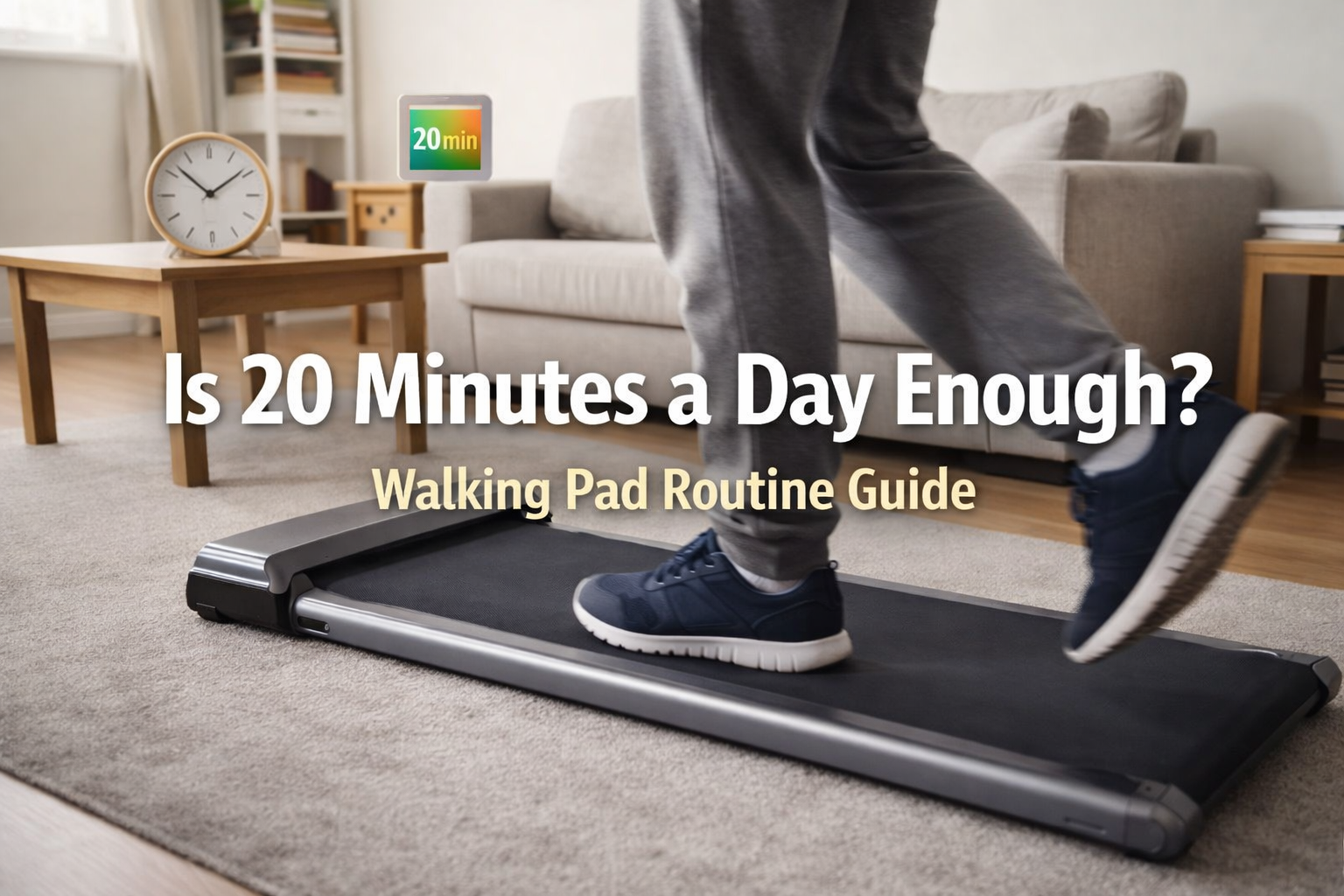
Is 20 Minutes a Day on a Walking Pad Enough?
Yes, 20 minutes a day on a walking pad is enough to make a meaningful difference for many people, especially if you are starting from a low activity level. It can help you move more consistently, reduce long sitting spells, build a routine, and support weight loss over time. But whether it is “enough” depends on what you want it to do.
If your goal is to start moving again, build a sustainable habit, and make home exercise feel realistic, 20 minutes a day can be a very solid place to start. If your goal is bigger weight-loss results, stronger fitness gains, or hitting broader weekly activity targets, it may need to be part of a bigger picture rather than the whole plan.
Jump to:
Why trust this guide?
I write these walking pad guides from the perspective of someone trying to make movement realistic, not perfect. My own weight-loss journey started after reaching around 27 stone, so I care much more about repeatable routines than impressive-but-unsustainable plans.
That is why this guide is not going to pretend 20 minutes a day is either useless or magical. In the real world, small habits done consistently can matter a lot. You can read more about me here, and if you want food support alongside movement, you can also grab my free meal plan here.
Quick answer
If you are asking whether 20 minutes a day on a walking pad is worth doing, the answer is yes.
If you are asking whether it is enough to transform your entire health, fitness, and weight-loss journey all by itself, the answer is usually no.
That is the balanced answer. Twenty minutes a day is often enough to start building momentum, improve your daily movement, reduce sitting time, and support weight loss habits. It is especially useful if you are a beginner, work from home, or struggle to fit movement into your day. But it works best when it becomes part of a bigger routine, not a box-ticking shortcut.
Is 20 minutes a day enough for health?
For many people, yes, it is enough to be genuinely worthwhile.
UK guidance recommends that adults aim for at least 150 minutes of moderate-intensity activity each week. Twenty minutes a day adds up to 140 minutes over seven days, which is very close to that benchmark. That does not mean every 20-minute walking pad session automatically counts as moderate intensity, but it does mean the idea is far more meaningful than people sometimes assume.
It is also worth remembering that the NHS says even a brisk 10-minute daily walk has health benefits and counts towards that weekly target. So 20 minutes is not some tiny, pointless amount. It is a decent chunk of movement, especially if you are building up from very little.
In practical terms, 20 minutes a day can help with:
- breaking up sedentary time
- building stamina gradually
- creating a repeatable routine
- supporting mood and energy
- making daily movement feel less intimidating
Is 20 minutes a day enough for weight loss?
It can help, yes, but it usually works best as part of a wider weight-loss routine.
Walking pads do not cause fat loss by magic. What they can do is make it easier to increase your daily movement, burn more energy over time, and stay more consistent. That matters a lot because consistency is where most people either win or lose.
If you are currently doing very little movement, 20 minutes a day can absolutely support weight loss. If you combine it with better food choices, improved consistency, and less all-or-nothing thinking, it can become a genuinely useful habit.
But if you are hoping 20 minutes a day will somehow override everything else, it is better to be honest: it is supportive, not magical.
For a deeper version of that, read Can a Walking Pad Help You Lose Weight?.
When 20 minutes a day is enough
Twenty minutes a day is often enough when your main goal is to start, rebuild momentum, or make movement automatic again.
It is often enough if you:
- are a beginner
- have been mostly sedentary
- work from home and want to sit less
- want to build a daily habit without overcomplicating it
- need something realistic you can repeat
- want to support a wider weight-loss plan
This is especially true if you have spent years thinking exercise “does not count” unless it is intense. For many people, 20 calm minutes done every day beats one dramatic workout they cannot sustain.
When 20 minutes is not enough on its own
There are also times when 20 minutes a day is a good start, but not the full answer.
It may not be enough on its own if you:
- want faster weight-loss results
- are already fairly active
- want to improve fitness more aggressively
- spend the rest of the day almost completely sedentary
- walk so slowly that the session is more standing than moving
That does not make it pointless. It just means you may eventually want to build on it by adding longer sessions, brisker walking, more daily steps, or some strength work during the week.
One of the biggest mistakes people make is assuming the answer has to be either “20 minutes is amazing” or “20 minutes is useless.” Real life is usually more sensible than that.
How does 20 minutes compare to UK weekly activity goals?
If you walked for 20 minutes every day, you would reach 140 minutes a week. That is close to the 150-minute weekly target often used in UK guidance for moderate activity.
That is encouraging, but there is an important catch: your pace matters. A very gentle amble may not feel like moderate activity in the same way a brisker walk does. So it is better to think of 20 minutes a day as a strong routine anchor rather than a magic guaranteed threshold.
Even so, it is still vastly better than doing nothing and sitting all day.
How to make 20 minutes count more
If you only have 20 minutes, you can still make it work well.
1. Be consistent
Five or six days a week will usually beat one longer session you keep skipping.
2. Pick the right pace
Do not obsess over going fast, but do aim for a pace that feels like real walking rather than drifting.
3. Use it to replace sitting, not compete with perfection
The big win is often replacing dead chair time with movement.
4. Split it if needed
Two 10-minute sessions can still be useful if that is what fits your day better.
5. Pair it with something repeatable
Morning emails, a podcast, an evening TV show, or a work call can make the habit easier to keep.
6. Build from there if needed
Twenty minutes does not have to be your forever number. It can be your starting number.
Simple 20-minute beginner routines
Option 1: Easy habit builder
- 5 minutes easy warm-in pace
- 10 minutes steady walking
- 5 minutes easy finish
Option 2: Work-from-home movement break
- 10 minutes before lunch
- 10 minutes late afternoon
Option 3: TV or podcast walk
- 20 minutes while watching or listening to something you already do daily
Option 4: Slightly brisker version
- 5 minutes easy
- 10 minutes brisker walking
- 5 minutes easy
If you are new to this, start with the version that feels most repeatable, not the version that looks toughest.
Is 20 minutes enough if you are on GLP-1?
For many people, yes, it is a very realistic place to start.
One of the most helpful things about a walking pad is that it can make movement feel lower-friction on days when motivation is mixed, energy is inconsistent, or you are trying to rebuild routine. That makes it a good fit for people who want calm, sustainable support rather than intense workouts.
It is still not a medical treatment by itself, and it is still not the whole story. But as part of a wider GLP-1 routine built around food, consistency, and sustainable habits, 20 minutes a day can absolutely be worth doing.
Best walking pad type for a 20-minute daily routine
If your plan is a simple 20-minute daily habit, you do not necessarily need the biggest or fanciest machine. You want something easy to live with, easy to step on, and easy to repeat.
That is why walking pads often beat bigger treadmills for this kind of reader. A compact machine that lives neatly in your home and feels low-effort to use is often a better routine builder than a more ambitious machine that feels like a project.
See WalkingPad UK options here
If you are still deciding what specs matter most, read Walking Pad Buying Guide: Weight Capacity, Speed, Belt Size and Storage.
My honest take
Yes, 20 minutes a day on a walking pad is enough to matter. That is the part a lot of people need to hear.
It is enough to start changing your day. It is enough to reduce sitting time. It is enough to build momentum. It is enough to support weight loss if it becomes part of a routine you can keep.
But it is also okay to admit that it may not be enough for every goal forever. The good news is that it does not need to be. A habit that starts at 20 minutes can grow. And even if it does not grow much, it can still be one of the most useful parts of your day.
People also ask
Can 20 minutes on a walking pad make a difference?
Yes. For many people, 20 minutes a day is enough to improve daily movement, reduce sedentary time, and support a healthier routine.
Is 20 minutes of walking enough exercise?
It can be a meaningful amount of exercise, especially for beginners or less active people. It may not cover every fitness goal by itself, but it is far from useless.
How many minutes a day should you use a walking pad?
There is no single perfect number. For many beginners, 20 minutes is a very reasonable starting point because it is long enough to matter and short enough to repeat.
Is it better to walk 20 minutes or do nothing?
Absolutely. A consistent 20-minute walk is much more helpful than waiting for the perfect workout and ending up doing nothing.
Can you split 20 minutes into two shorter sessions?
Yes. Two 10-minute sessions can still be useful if that makes the habit easier to fit into your day.
What happens if I walk 20 minutes every day?
You are likely to increase daily movement, sit less, and build a more reliable habit. Over time, that can support better health and weight-loss consistency.

FAQ
Is 20 minutes on a walking pad enough to lose weight?
It can help, especially if you are currently inactive and use it consistently alongside better food choices and a wider routine.
How fast should I walk for 20 minutes?
Use a pace that feels like real walking rather than drifting, but not so fast that it becomes unsustainable or unpleasant.
Is 20 minutes a day enough for beginners?
Yes. For many beginners, 20 minutes is one of the best starting points because it feels manageable and repeatable.
Can I do 20 minutes a day while working from home?
Yes. It can work especially well as a scheduled break, before work, after work, or during lighter admin tasks depending on your setup.
Should I do 20 minutes every day or longer sessions less often?
For habit-building, daily shorter sessions often work extremely well. Consistency usually matters more than occasional heroic effort.
Is a walking pad worth it if I only use it for 20 minutes?
Yes, it can be, especially if those 20 minutes become a reliable daily habit that you would not otherwise do.
Related reading
Friendly note: This article is based on public health guidance, practical routine-building, and lived experience rather than personal medical advice. If you have mobility issues, pain, or a condition affecting exercise tolerance, get personalised advice before starting a new routine.
Discover more from Healthy Weight Loss GLP1
Subscribe to get the latest posts sent to your email.

2 thoughts on “Walking Pad Routine: Is 20 Minutes a Day Enough?”
Comments are closed.