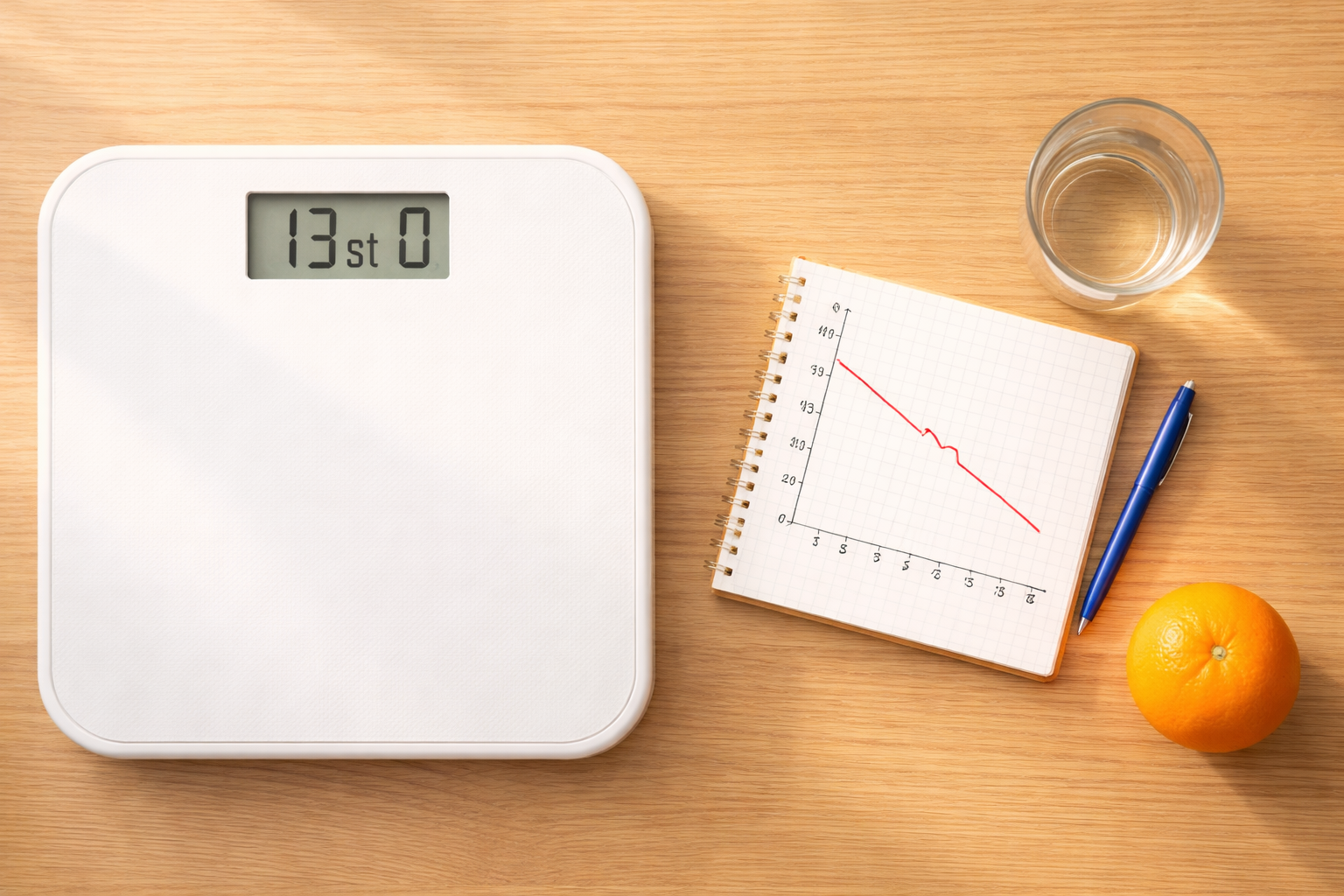

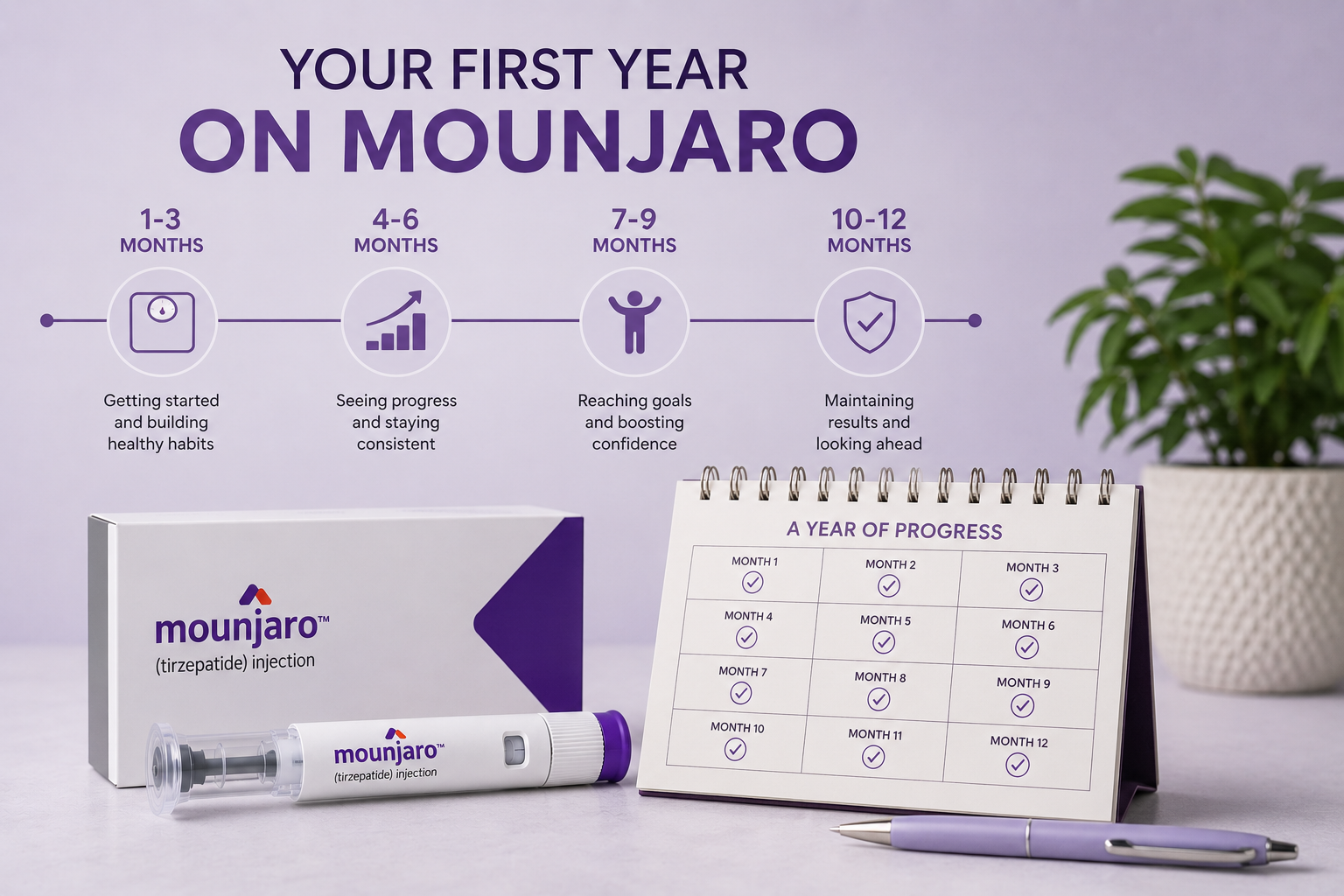
A year on Mounjaro isn’t just 52 injections and a lower number on the scales — it’s a structural change to your relationship with food, your energy patterns, your body composition, and your sense of what’s possible. This is the honest UK retrospective on what year one actually looks like, month by month, what typically goes right, what commonly surprises people, and how to set yourself up for year two. Written from the perspective of a site built around Alan’s 12-month Mounjaro journey and the cumulative learnings from 49 sister posts covering every aspect of this treatment.
For the full treatment picture see the Complete GLP-1 Weight Loss Guide. This post brings together threads from across this site into a single year-one view.
The big shape of year one
Most UK adults starting Mounjaro for weight management will see:
- Months 1–3: rapid initial weight loss (often 6–12kg), titration through early doses, significant appetite change, common side effects during dose steps
- Months 4–6: continued steady loss (typically 4–8kg), stabilising on a working dose (5mg, 7.5mg, or 10mg for most), habit formation around injection routine
- Months 7–9: slower but continued progress (2–5kg), identity shifts become noticeable, possible dose increase to 12.5mg or 15mg if progress slows
- Months 10–12: approach to individual goal or plateau, consolidation phase, thinking about maintenance
Typical total weight loss at 12 months: 15–22% of starting body weight for adherent users. Individual variation is wide — some users hit 25%+; some reach 8–12%. Both are valid outcomes depending on starting point, consistency, and individual response.
Month-by-month: what typically happens
Month 1
Dose: 2.5mg weekly.
The adjustment month. You’re learning:
- How to do the injection (see How to Inject Mounjaro First Time)
- What side effects you personally experience
- How food tastes different now
- The concept of “food noise” actually being quieter
Weight loss: typically 1–4kg. A lot of this is water and reduced gut content. Real fat loss starts later.
Common surprises: how quickly appetite changes; how foods you liked suddenly seem too sweet, too rich, or uninteresting; how nausea can come out of nowhere.
Key action: establish your injection routine (see Mounjaro Injection Day Routine UK).
Month 2
Dose: 5mg weekly.
The first dose step. Side effects often amplify briefly, then settle. By end of month 2, many users feel stable on 5mg.
Weight loss: another 2–4kg. Pace is faster than month 1 because you’re fully in deficit now.
Common surprises: eating significantly less than you remembered possible; portions that would have been small before now feeling generous; dramatic reduction in snacking between meals.
Key action: nail your protein strategy (see High-Protein Breakfast, High-Protein Lunch, High-Protein Dinner). This is the foundation of protecting muscle through weight loss.
Month 3
Dose: 7.5mg weekly (for most users following standard titration).
The commitment month. By now you’ve been on Mounjaro for 12 weeks and established the rhythm. Clothes are fitting differently. Compliments and questions from others are starting.
Weight loss: 2–4kg. Total 5–12kg over three months.
Common surprises: people who haven’t seen you in 3 months react strongly; sleep may improve noticeably; energy patterns stabilise.
Key action: start strength training if you haven’t already (see Dumbbell Workout or Bodyweight Workout). Protecting muscle matters now that fat loss is established.
Month 4
Dose: often 7.5mg or 10mg.
The “new normal” month. The early-adjustment period is over. Injection feels routine. Eating patterns are established. Side effects are typically minimal.
Weight loss: 2–3kg. Pace starts to moderate.
Common surprises: realising how much time you used to spend thinking about food; noticing that certain eating-adjacent social situations feel different (buffets, family meals, work lunches).
Key action: develop your “eating with others” approach. See Food Noise Explained for the mental framing.
Month 5
Dose: 10mg for many users.
The consistency month. You’ve proven to yourself this works. Questions shift from “is this doing anything?” to “how much more can I lose?”
Weight loss: 1.5–3kg.
Common surprises: weight loss pace noticeably slower than months 1–3 even though adherence is identical. This is normal — your metabolism has adapted.
Key action: don’t panic about the slowdown. Focus on protein, training, and long-term trajectory. See Progressive Overload Explained UK.
Month 6
Dose: 10mg or 12.5mg depending on progress.
The halfway point. Many users at their first “before and after” photo comparison are genuinely surprised at the change.
Weight loss: 1–2.5kg. Total over 6 months: 12–20kg for most users.
Common surprises: identity shift starts happening — you catch yourself thinking of yourself in new ways; old clothes don’t fit; old self-image doesn’t fit. See Identity Shift After Weight Loss UK.
Key action: take measurements and progress photos. They capture what the scale hides.
Month 7
Dose: 10mg or 12.5mg.
The “how long do I stay on this” month. You’re seeing significant progress; you’re wondering what the endpoint looks like. Start having this conversation with your prescriber.
Weight loss: 1–2kg.
Common surprises: plateaus become more common — 1–2 week stalls followed by a drop. Normal.
Key action: audit your protein, sleep, and training consistency. The “simple” stuff still matters.
Month 8
Dose: 12.5mg or 15mg if progress is stalling.
The mid-journey reassessment. You’re 32 weeks in. Major life events have happened (holidays, work stress, illness). You’ve injected 32+ times. The routine is automatic.
Weight loss: 0.5–2kg.
Common surprises: your food preferences have genuinely changed — foods you craved 8 months ago don’t appeal; new foods have become default.
Key action: notice and appreciate the shifted preferences. These tend to persist even after eventual medication tapering.
Month 9
Dose: 12.5mg or 15mg.
The body composition month. Scale changes slow; but your body is still changing. Body composition continues shifting — more muscle retention if you’ve been training, continued fat loss, visible recomposition.
Weight loss: 0.5–1.5kg.
Common surprises: your training capacity is often better than month 3 despite being smaller — relative strength (per kg bodyweight) has increased.
Key action: use body composition measurements if you have them (see Best Body Composition Scale UK 2026).
Month 10
Dose: 15mg for most users still losing.
The “is this my endpoint” month. For users at or near their goal, maintenance planning starts. For users still losing, maintenance is visible on the horizon.
Weight loss: 0.5–1.5kg.
Common surprises: emotional surprises about completing weight loss — some users feel unexpected sadness, loss of purpose, or mixed feelings.
Key action: think about what maintenance will look like. Discuss with prescriber.
Month 11
The “what comes next” month. Goal weight approaches or is reached. Conversations with prescriber shift to long-term plans.
Weight loss: 0–1.5kg. Some users are now deliberately holding steady.
Common surprises: realising you’ve achieved what seemed impossible a year ago; also realising that the journey has permanently changed some things.
Key action: formalise your maintenance plan — dose, nutrition framework, training, long-term prescribing arrangements.
Month 12
The anniversary month. A full year. Typical cumulative weight loss: 15–22% of starting body weight, achieved while preserving (with protein + training) most of your lean mass.
Common reflections at 12 months:
- “I’ve spent less time thinking about food in the last year than any year of my adult life.”
- “My clothes don’t fit; all my clothes don’t fit.”
- “I look different. I also feel different in ways that aren’t visible.”
- “I’m not sure what to do with myself when weight loss stops being the main focus.”
- “Should I be on this forever?”
Key action: take the one-year stock-take below, then plan year two.
The one-year stock-take
Questions to answer for yourself at the 12-month mark:
Physical
- Total weight change
- Waist, hip, thigh measurements change
- Body composition change (if measured)
- Clothing size change
- Fitness markers: strength, endurance, daily energy
- Sleep quality change
- Blood pressure, cholesterol, HbA1c, blood sugar changes (if tracked)
- Any new health issues emerged?
- Any pre-existing health issues resolved or improved?
Behavioural
- Weekly exercise pattern: established or still developing?
- Nutrition pattern: protein target consistently hit?
- Alcohol: reduced or same?
- Sleep: improved or same?
- Injection routine: automatic?
Mental/emotional
- Relationship with food: different? How?
- Body image: improved, worse, or complicated?
- Energy levels and mood: more stable?
- Any unexpected challenges — grief for old identity, social discomfort, relationship shifts?
Practical
- Provider relationship: working well?
- Injection supplies, storage, routine: all set?
- Financial: sustainable budget?
- Medical team communication: everyone knows what’s happening?
Write these down. Compare them a year from now.
Year two: what comes next
Four common year-two paths:
Path 1: Continued loss
If you’re not yet at your goal weight, year two is continued loss at a slower pace. Expect 3–8% additional weight loss in year two for users maintaining medication. Adherence to protein, training, and routine remains the lever.
Path 2: Maintenance on medication
Continuing Mounjaro at the same or reduced dose to maintain weight loss. This is clinically appropriate for many users, especially those with significant obesity risk factors. Ongoing costs and prescription relationship continue indefinitely, but the work of daily discipline is reduced.
Path 3: Taper and maintain without medication
Some users attempt to taper off over months, testing whether behavioural changes alone sustain weight. Evidence: most users regain some weight after stopping GLP-1s. The size of regain varies widely based on maintained habits. Typical regain over 2 years post-medication: 25–60% of original weight loss.
If you attempt this path, maintain nutrition and training discipline rigorously. Be prepared to restart medication if regain becomes significant.
Path 4: Dose reduction as a middle path
Some users drop to lower doses (2.5–5mg) indefinitely, getting modest appetite support without the full medication effect. This can maintain weight loss with lower costs and lower side effect exposure.
Any of these paths is valid; the right one depends on your specific health picture, finances, and goals. Discuss with your prescriber.
The non-scale wins
One year in, the changes that don’t show on the scale often matter most:
- Joint pain often improves significantly as body weight drops
- Sleep apnea often improves or resolves for users with significant weight loss
- Fasting glucose and HbA1c improve for users with pre-diabetes or type 2 diabetes
- Blood pressure often drops (many users reduce antihypertensive doses)
- Cholesterol profile improves
- Mobility and everyday physical tasks become easier
- Energy levels improve (sometimes dramatically)
- Psychological well-being improves for many users, particularly around body image and confidence
- Food doesn’t occupy mental space the way it used to
These benefits often outlast any weight change. They’re the real return on the year.
The things that won’t magically fix
Honest truths about what a year on Mounjaro doesn’t do:
- It doesn’t fix underlying mental health issues; depression, anxiety, and eating disorder patterns may need separate treatment
- It doesn’t resolve trauma or grief; weight was often a coping mechanism for something; that something remains
- It doesn’t give you confidence; confidence comes from your relationship with yourself, not your size
- It doesn’t fix relationships that were strained before treatment; sometimes weight change stresses relationships further
- It doesn’t solve career, financial, or life dissatisfaction that felt weight-adjacent
- It doesn’t mean food has no emotional meaning; it just reduces food’s daily pull
Be prepared for these. Medication is physiological; life stays psychological.
What Alan learned
A summary of what the site’s host, Alan, took from his year (January 2025 to January 2026 on Mounjaro, 2.5mg through 15mg, 7 stone lost, emergency gallbladder surgery in February 2026):
- Protein is the foundation. Lean mass protection is the difference between losing fat and just losing weight.
- Routine beats motivation. The injection routine, the training routine, the meal routine. Routines survived weeks when motivation didn’t.
- Strength training changed the outcome. Not the appearance; the actual body composition.
- Private prescribing was the right choice for access. NHS eligibility wasn’t clear; private pathway provided clarity and consistency.
- The gallbladder episode happened. Rapid weight loss carries gallbladder stone risk. Tell medical teams your medication immediately in any emergency.
- Year one is just the beginning. Maintenance thinking should start at month 9, not month 12.
- The mental side surprised most. Weight loss isn’t just physical; identity, social dynamics, and emotional patterns all shift.
- Community helps. Online communities (used carefully), family support, and professional input together outperformed any single channel.
- The tools mentioned on this site matter more at the margins than at the start. In year one, basic consistency dominates; in year two, the details start mattering more.
- Gratitude outlasts scale numbers. A year on, the specific pounds matter less than the cumulative improvements.
Resources to revisit
As you enter year two, these posts from across the site cover specific topics you might now want to revisit:
- Nutrition foundation: Breakfast, Lunch, Dinner
- Training: Dumbbell Workout, Bodyweight Workout, Progressive Overload
- Supplements: Vitamin D3+K2, Omega-3, Protein Powder, Probiotic
- Mental side: Food Noise, Identity Shift
- Travel and life: Travel Guide, Surgery/Anaesthesia, Flu/Illness
- The full picture: Complete GLP-1 Weight Loss Guide
For anyone still considering starting
If you’re 12 months in reading this as someone’s partner, friend, or family member considering Mounjaro:
Year one is manageable. The side effects are real but usually modest. The weight loss is real and significant for most adherent users. The commitment required is moderate: a weekly injection, a protein-focused diet, a strength training habit, and honest engagement with a prescriber.
The barriers that feel biggest pre-treatment (can I do the injection, can I afford it, what will people say, will it work for me) are usually smaller in reality than in anticipation.
For starting points: How to Get Mounjaro in the UK, First Week on Mounjaro, First Month on Mounjaro UK.
The summary
A year on Mounjaro typically produces 15–22% weight loss, significant health marker improvements, and meaningful identity and behavioural change for adherent users. The journey has predictable rhythms — rapid early loss, mid-journey plateaus, late-year consolidation. The mental and social adjustments are often as significant as the physical. Year two involves decisions about maintenance, continued loss, or tapering — all legitimate paths depending on individual circumstances.
If you’re at the start of your year: be patient, follow the fundamentals, build the habits. If you’re at the end of your year: take stock, celebrate what’s been accomplished, and plan deliberately for what comes next.
For everything else: Complete GLP-1 Weight Loss Guide.
Medical note: this retrospective is composed from general GLP-1 clinical patterns and the site’s experience. Your specific journey will vary. Always work with a qualified prescriber who knows your full medical history. Report adverse events to the MHRA Yellow Card Scheme.
Discover more from Healthy Weight Loss GLP1
Subscribe to get the latest posts sent to your email.